
What Makes Corporate Video Production Different From Commercial Advertising?
February 24, 2026
Video has become the most powerful storytelling tool in modern business. It explains ideas faster than text, builds emotional connection more effectively than static images, and establishes credibility in ways no brochure ever could. Yet despite its popularity, many businesses still treat all video as if it serves the same purpose.
That’s where costly mistakes happen.
Corporate video production and commercial advertising may look similar on the surface—professional cameras, lighting, actors, editing—but beneath that surface, they are built for very different missions. Understanding those differences is not just helpful; it’s essential for making smart marketing and communication decisions.
For businesses operating in Covington West, clarity here can mean the difference between video that works quietly in the background and video that actively drives growth.
Understanding Video as a Strategic Business Tool
Video should never be created just because “everyone else is doing it.” When a video lacks a clear purpose, it becomes background noise. When it’s created with intention, it becomes a powerful business tool.
Think of video like choosing a way to travel. You could ride a bicycle, drive a car, or take an airplane. Each option gets you where you need to go—but only if it’s used for the right situation. Choosing the wrong one can waste time, money, and effort.
Corporate video production and commercial advertising work the same way. Both use video, but each is designed for a different business goal.
So the real strategic question isn’t, “Should we make a video?”
It’s “What do we want this video to accomplish?”

Defining Corporate Video Production
Corporate video production is centered on clarity, trust, and alignment. Its role is to help people understand your organization—how it works, what it believes in, and why it exists.
These videos don’t rush the viewer. They respect attention instead of hijacking it. Corporate video acts like a guided tour rather than a sales pitch, allowing viewers to build confidence at their own pace.
In many cases, corporate videos quietly influence decisions long before a sale ever occurs.
What Corporate Videos Are Designed to Achieve
Corporate videos are designed to create understanding, which is the foundation of trust. They often aim to:
- Explain complex services or processes in simple terms
- Align employees around mission, culture, and expectations
- Demonstrate expertise without aggressive selling
- Reassure stakeholders that the business is stable and credible
For example, a corporate brand video on a company’s homepage may never directly ask for a sale—but it can dramatically increase conversion rates by reducing uncertainty and answering unspoken questions.
Common Types of Corporate Videos
Corporate video production includes a wide ecosystem of formats, such as:
- Company overview and brand story videos
- Corporate interviews with leadership or subject experts
- Training, onboarding, and compliance videos
- Internal announcements and operational updates
- Case studies and testimonial-style corporate narratives
These videos often serve multiple departments—marketing, HR, sales, operations—making them highly valuable long-term assets.
Internal vs External Corporate Videos
Corporate videos typically fall into two functional categories:
- Internal corporate videos focus on employees and stakeholders. They reduce training costs, improve consistency, and strengthen company culture by delivering the same message to everyone.
- External corporate videos communicate with clients, investors, partners, and communities. These videos help external audiences understand your value without feeling sold to.
Both types prioritize accuracy, tone, and clarity over hype.
Defining Commercial Advertising
Commercial advertising is built for speed, visibility, and persuasion. These videos operate in competitive environments where attention is scarce and decisions happen fast.
A commercial ad doesn’t explain everything—it highlights one compelling idea and pushes it forward with urgency. It’s not a conversation; it’s a moment designed to interrupt and influence.
The Core Purpose of Commercial Ads
Commercial advertising exists to:
- Drive immediate action (clicks, calls, purchases)
- Promote specific products or offers
- Increase brand recall quickly
- Influence buying behavior in crowded markets
If corporate video builds trust slowly, commercial advertising strikes while attention is hot.
Typical Formats Used in Commercial Advertising
Commercial ads are commonly seen as:
- TV and streaming commercials
- Paid social media video ads
- YouTube pre-roll and mid-roll videos
- Short-form promotional clips for campaigns
These formats prioritize brevity, memorability, and emotional punch over depth.
Corporate Video vs Commercial Advertising: The Big Picture
Looking at both side by side reveals why confusion leads to poor results.
Purpose and Intent
- Corporate video exists to inform, educate, and establish trust.
- Commercial advertising exists to persuade, promote, and convert.
Neither is superior—each simply serves a different stage of the customer journey.
Target Audience Differences
Corporate video often speaks to:
- Existing clients
- Employees
- Investors
- Long-term partners
Commercial advertising targets:
- Prospective buyers
- Cold or unaware audiences
- Broad demographic segments
The more familiar the audience, the more effective corporate video becomes.
Messaging Style and Tone
Corporate video tone is typically:
- Measured and confident
- Transparent and authentic
- Focused on clarity
Commercial advertising tone is often:
- Bold and energetic
- Emotionally driven
- Designed to stand out instantly
Tone follows intent.
Distribution Channels
Corporate videos usually live on:
- Company websites
- LinkedIn and B2B platforms
- Email campaigns
- Internal systems
Commercial advertising dominates:
- Paid social media
- Streaming platforms
- Digital and broadcast ad networks
The channel shapes the content.
Storytelling Approaches Compared
Storytelling reveals the deepest contrast between these two approaches.
Long-Form vs Short-Form Narratives
Corporate videos allow time to build context, explain reasoning, and show process—like a documentary. Commercial ads compress stories into seconds, like movie trailers.
Both tell stories—but on very different timelines.
Emotional vs Informational Storytelling
Corporate video leans toward informational storytelling supported by emotion, while commercial advertising leads with emotion first, trimming details to maintain momentum.
One deepens understanding. The other accelerates decision-making.
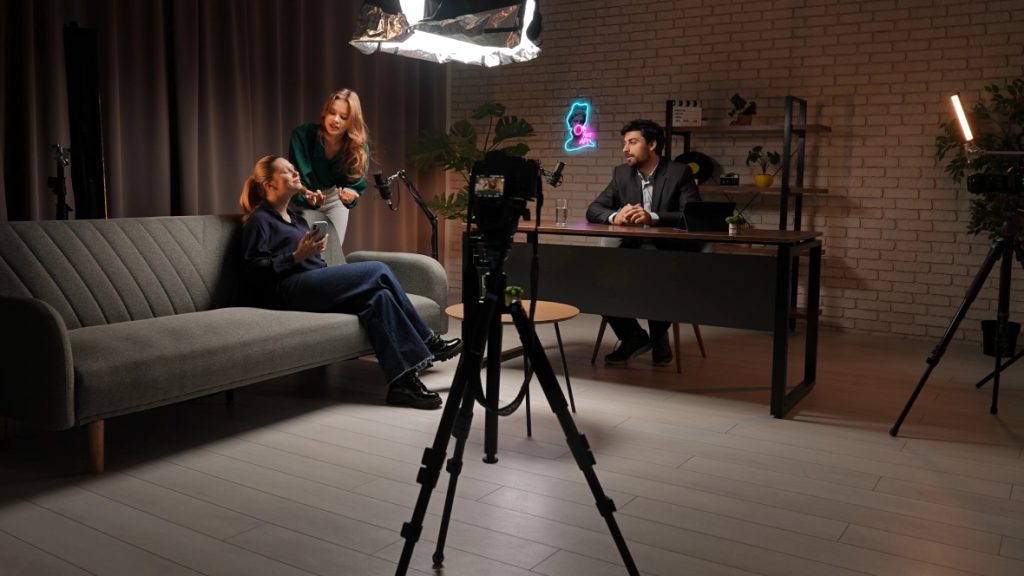
Production Style and Creative Direction
Production choices reflect strategic goals, not just aesthetics.
Visual Aesthetics
Corporate videos emphasize:
- Real environments
- Natural lighting
- Authentic people
Commercial ads often use:
- Stylized visuals
- Dramatic lighting
- Fast-paced editing
The difference lies in realism versus spectacle.
Scriptwriting Differences
Corporate scripts prioritize:
- Accuracy
- Logical flow
- Brand consistency
Commercial scripts prioritize:
- Hooks and slogans
- Emotional triggers
- Memorability
One educates; the other motivates.
Budget, Timeline, and ROI Expectations
Understanding cost structures prevents disappointment.
Investment Levels
Corporate videos are typically:
- Moderate in budget
- Designed for reuse
- Valuable over years
Commercial advertising often includes:
- Higher production spend
- Media placement costs
- Shorter shelf life
Each delivers ROI differently.
Measuring Success
Corporate video success is measured through:
- Engagement time
- Brand trust
- Internal alignment
- Lead quality
Commercial advertising success is measured by:
- Click-through rates
- Conversions
- Cost per acquisition
Metrics must match intent.
When Corporate Video Is the Better Choice
Corporate video is the right choice when you need to:
- Build long-term credibility
- Explain complex services
- Strengthen internal communication
- Support sales with trust-building tools
If understanding matters more than urgency, corporate video wins.
When Commercial Advertising Makes More Sense
Commercial advertising is ideal when you need to:
- Launch a product or promotion
- Drive immediate sales
- Increase short-term visibility
- Compete in crowded markets
If speed matters more than depth, advertising delivers.
Using Both Together for Maximum Impact
The most effective video strategies combine both approaches.
Corporate video builds trust and clarity.
Commercial advertising drives traffic and action.
Together, they create momentum without sacrificing credibility.
Why Choose UTurn Productions in Covington West
At UTurn Productions, we don’t just produce videos—we design solutions. Businesses in Covington West rely on us to help them choose the right video approach for their specific goals.
Our work blends:
- Strategic thinking
- Creative storytelling
- Purpose-driven execution
Whether you need corporate clarity or commercial impact, we help you move forward with confidence.
UTurn Productions Serving the Covington West Community and Beyond in Sugar Land
UTurn Productions is dedicated to serving the diverse needs of the local community of Sugar Land, including individuals residing in neighborhoods like Covington West. With its convenient location near landmarks such as the Covington West Park and major intersections like Silver Lining Ln and Gannoway Lake Dr (coordinates: 29.64533219325887, -95.63686652261649), we offer corporate video production Sugar Land services.
Get Corporate Video Production Services at Covington West Now
Navigate from Covington West to UTurn Productions Now
Conclusion
Corporate video production and commercial advertising are not interchangeable tools—they are complementary strategies. One builds understanding and trust over time. The other accelerates decisions in the moment.
When you understand the difference, video stops being an expense and starts becoming an asset.
FAQs
1. Can corporate video replace advertising?
No. Corporate video supports trust, while advertising drives action. They work best together.
2. Are commercials always promotional?
Yes. Commercial advertising always aims to influence behavior or buying decisions.
3. Which video lasts longer?
Corporate videos typically have a longer useful lifespan.
4. Is corporate video only for large companies?
No. Small businesses benefit greatly from credibility-building corporate video.
5. How do I decide which video to start with?
Define your goal—education or conversion—and the answer becomes clear.

Stay Ahead of the Curve
or call us now at
(346) 472-5495
Related Blogs

What Equipment Is Used In Modern Film Production?
How A Corporate Video Production Company Develops Video Strategy

How Video Production Companies Balance Originality With Brand Recognition
Let’s Begin Sharing Your Story
Get in touch with us today to discover how U-Turn Productions can bring your vision to life.


